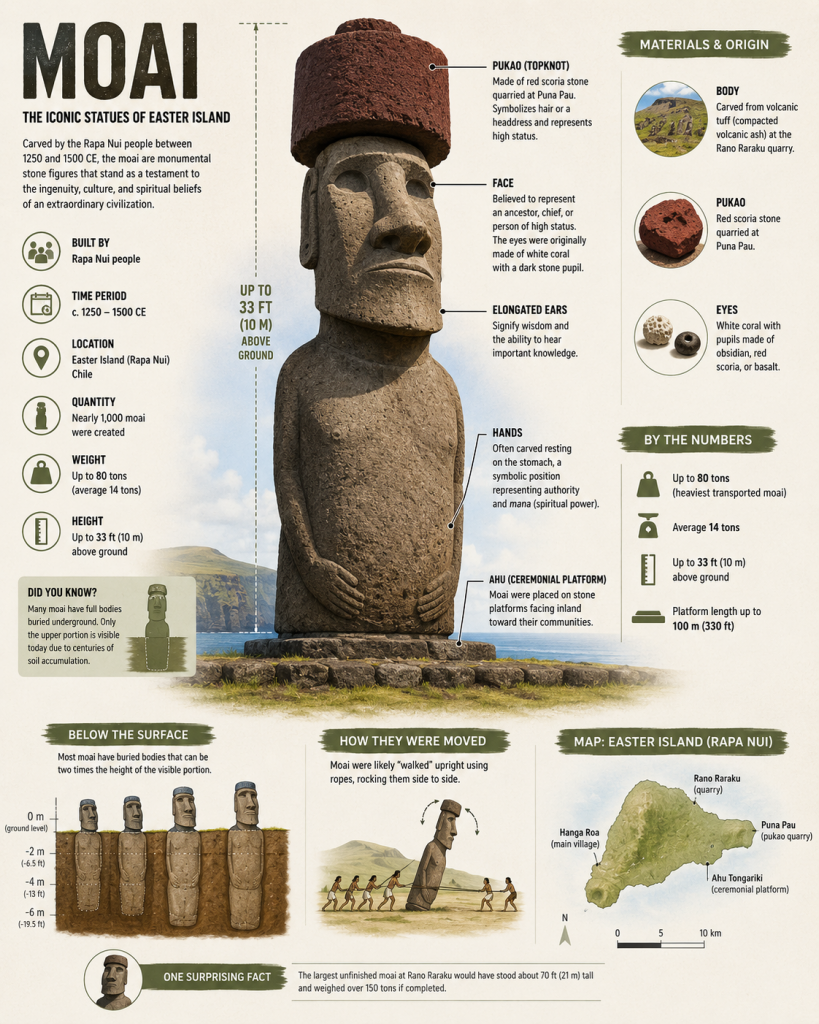
The famous Easter Island heads were built by the indigenous people of Rapa Nui people, who lived on Easter Island in the southeastern Pacific Ocean.
A few key facts:
- The statues are called moai.
- Most were carved between about 1250 and 1500 CE.
- They were carved from volcanic tuff (compressed volcanic ash) at the quarry of Rano Raraku.
- Nearly 1,000 moai were created.
- The statues represented important ancestors, chiefs, or people of high status.
- Although often called “heads,” many moai actually have full bodies buried beneath centuries of soil accumulation.
One of the biggest mysteries was how the Rapa Nui moved statues weighing up to 80 tons across the island. Modern experiments suggest they may have “walked” the statues upright using ropes, rocking them from side to side, though other transport methods may also have been used.
What did they look like originally?
Many moai originally had:
- Eyes made from white coral and dark stone.
- Red stone topknots called pukao made from rock quarried at Puna Pau.
- Platforms called ahu on which they stood facing inland toward their communities.
Were they built by aliens?
No credible archaeological evidence supports alien involvement. The tools, quarry sites, unfinished statues, transport routes, and oral traditions all point to the Rapa Nui people as the builders.
One surprising fact: the largest unfinished moai at Rano Raraku would have stood about 70 feet (21 meters) tall and weighed over 150 tons if completed.