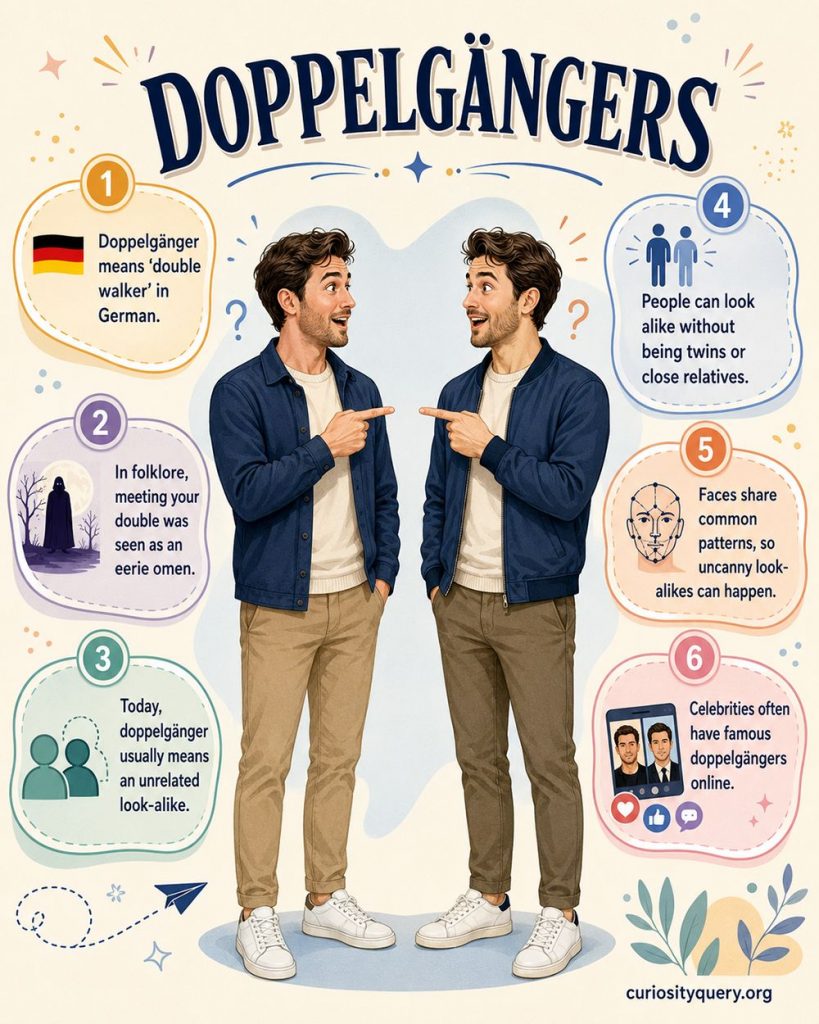
A doppelgänger is someone who looks remarkably similar to another person but is not their twin or close relative.
The word comes from German:
- doppel = double
- gänger = walker or goer
So it roughly means “double-walker.”
In folklore, a doppelgänger was sometimes described as a ghostly duplicate of a living person, and seeing your own was considered a bad omen. Today, the term is usually harmless—we use it for strangers, celebrities, or historical figures who happen to look strikingly alike.
True look-alikes are possible because human faces share a limited set of features and proportions, so unrelated people can occasionally have very similar eyes, noses, face shapes, and expressions. They usually are not genetically identical, even when the resemblance is uncanny.
1. Strong look-alikes can share facial genetic variants
A 2022 Cell Reports study examined 32 pairs of unrelated look-alikes collected through photographer François Brunelle’s project. Facial-recognition programs identified a subset whose resemblance was strong enough to be comparable to that of identical twins in photographs.
The closest-matching pairs shared similarities in numerous genetic variants, particularly variants associated with facial structure. However, they differed much more in their epigenomes—chemical controls affecting gene activity—and their oral microbiomes.
Interesting implication: Two strangers may arrive at a similar-looking face partly because they inherited a similar combination of face-shaping genetic variants, even though they are not closely related overall.
2. Some look-alikes also shared physical and lifestyle traits
The same study found similarities among certain closely matched pairs in traits such as height, weight and smoking habits. The researchers suggested that some of these similarities might reflect shared genetic influences rather than the men simply copying one another.
This does not mean every doppelgänger will behave alike. The sample was small, and questionnaire-based lifestyle findings are much less conclusive than the facial-genetics result.
3. Looking alike does not mean having the same personality
A separate study of unrelated look-alikes found essentially negligible similarity in major personality traits and self-esteem. The look-alike pairs also generally reported little unusual familiarity or emotional closeness when they met.
That challenges the popular idea that doppelgängers somehow share personalities, destinies or an immediate mysterious connection.
4. Your brain uses context to separate similar faces
A 2024 neuroscience study investigated how the brain distinguishes highly similar faces. In macaques, learned contextual clues helped make overlapping facial representations more separable within the brain’s face-processing system.
In everyday terms, when two people look nearly identical, your brain may rely more heavily on context—such as hairstyle, voice, location, clothing or who they are usually seen with—to tell them apart.
5. Faces resembling our own can affect trust
Experiments using digitally manipulated faces found that people were more likely to trust someone whose face subtly resembled their own. The participants did not necessarily realize that the face had been altered to resemble them.
Researchers interpret this as a possible unconscious kin-recognition response: facial resemblance may act as a weak signal that someone could be genetically related.
The biggest takeaway
Doppelgängers are not secret twins and probably do not share identical personalities. But extremely convincing look-alikes may share particular combinations of genes involved in facial development. Their resemblance is therefore not purely a visual coincidence—even though the rest of their genomes, experiences and identities can remain very different.
One caution: the headline-grabbing genetics study involved a relatively small and specially selected group, so it does not prove that everyone has a genetically similar doppelgänger somewhere in the world.
Why do they occur?
They occur because human faces are built from a large but limited collection of features eye spacing, nose shape, jawline, cheekbones, skin tone, hairline and many others. With billions of people, some unrelated individuals will inherit unusually similar combinations.
The main reasons are:
Genetics: Facial shape is highly influenced by many genes working together. Unrelated people can coincidentally carry similar variants that affect specific facial features. A study of extreme look-alikes found that the strongest-matching pairs shared more face-related genetic similarities than expected, despite not being close relatives.
Probability: Faces are enormously varied, but they are not infinitely varied. As the human population grows, the chance of two people having a similar combination of recognizable features increases.
Shared ancestry: People from the same broad ancestral populations may share certain common facial traits, even when they have no recent family connection.
Development and environment: Age, body weight, facial expressions, hairstyle, grooming and even camera angle can make two moderately similar people appear nearly identical.
How our brains recognize faces: We often focus on a few dominant features rather than measuring every detail. Two people may seem like perfect copies at first glance, while closer examination reveals differences in their ears, teeth, facial proportions or skin details.
So doppelgängers are essentially a genetic and statistical coincidence, not evidence of secret twins or an exact biological duplicate. Even very convincing look-alikes normally have substantially different genomes overall.