A returning boomerang comes back because of a clever combination of shape, spin, and aerodynamics.
The Short Version
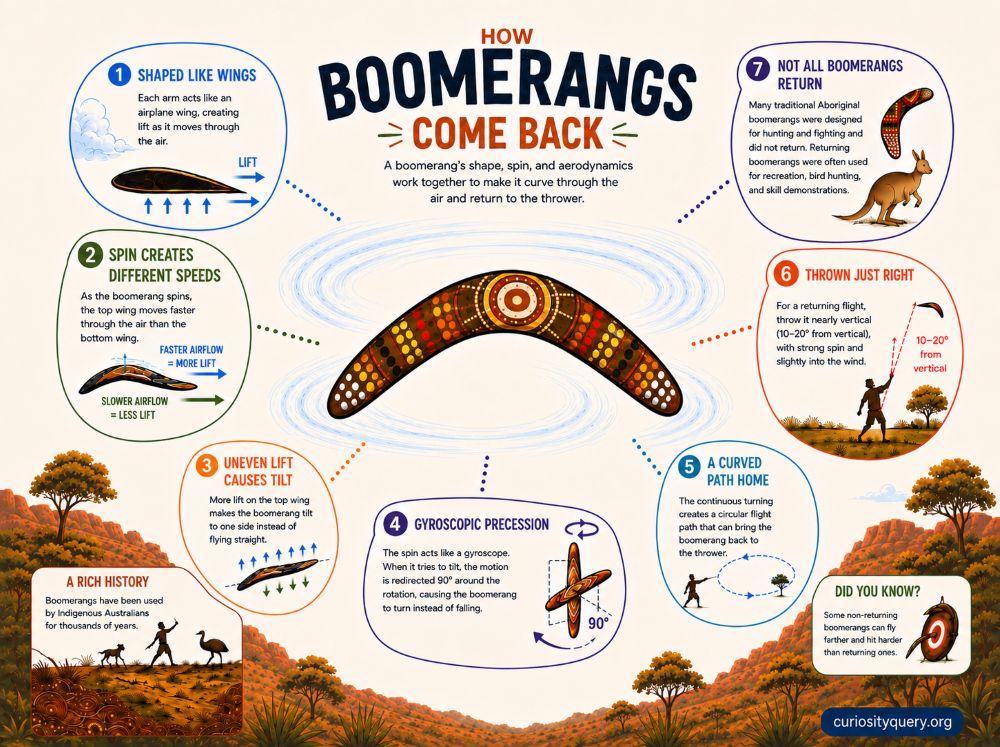
A boomerang is shaped like two airplane wings joined together. When you throw it with a lot of spin:
- The wings generate lift, just like an airplane wing.
- The top wing moves through the air faster than the bottom wing because of the spin.
- The faster-moving wing creates more lift.
- This uneven lift causes the boomerang to slowly tilt and turn instead of flying straight.
- The continuous turning creates a circular flight path that can bring it back to you.
Why the Top Wing Gets More Lift
Imagine the boomerang spinning while moving forward:
- The upper wing’s rotational speed adds to the forward speed.
- The lower wing’s rotational speed subtracts from the forward speed.
For example:
- Forward speed: 30 mph
- Wing tip spin speed: 20 mph
Upper wing: 50 mph through the air
Lower wing: 10 mph through the air
Since lift increases with airspeed, the upper wing produces more lift than the lower wing.
The Gyroscope Effect
A spinning boomerang behaves like a gyroscope.
When the unequal lift tries to tilt it, the spinning motion redirects that force 90 degrees around the rotation. This phenomenon, called gyroscopic precession, causes the boomerang to turn sideways rather than simply tip over.
The result is a smooth curved flight path.
Why You Don’t Throw It Flat
Most people imagine throwing a boomerang like a frisbee, but that’s wrong.
A returning boomerang is usually thrown:
- Nearly vertical (about 10–20° from vertical)
- With strong spin
- Slightly off the direction of the wind
Thrown correctly, it climbs, curves around, slows down, and returns near the thrower.
Did Ancient Boomerangs Always Return?
No.
Many traditional boomerangs used by Indigenous Australians were designed as hunting and fighting tools and did not return. Returning boomerangs were often used for recreation, bird hunting, and skill demonstrations. Some ancient non-returning boomerangs could fly farther and hit harder than returning ones.
A Fun Comparison
A returning boomerang is essentially:
- A spinning gyroscope
- Made of airplane wings
- Flying in a controlled curve
That’s why it doesn’t magically reverse direction—it continuously turns throughout its flight until it loops back toward where it started.