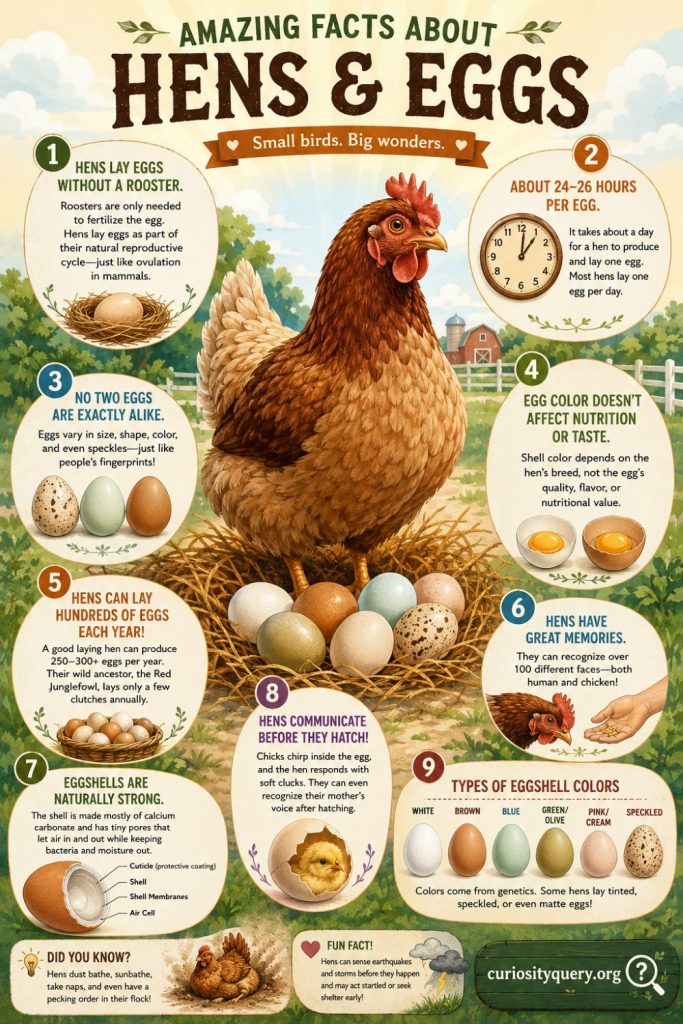
Hens lay eggs whether or not a rooster is present because egg production is part of a hen’s natural reproductive cycle, much like ovulation in humans.
Here’s what happens:
- A hen’s ovary releases a yolk (an egg cell).
- As the yolk travels through the hen’s reproductive tract, layers of egg white, membranes, and finally a shell are added.
- The completed egg is laid, usually about 24–26 hours after the process begins.
The key distinction is:
- Without a rooster: The egg is unfertilized and cannot develop into a chick.
- With a rooster: If mating occurs before the egg is formed, the egg may be fertilized and can develop into a chick if incubated.
A good analogy is that a hen laying an egg is similar to mammals releasing reproductive cells on a regular cycle. The rooster’s role is not to make the hen produce eggs—it is to fertilize them.
Curiosity Query Fun fact
Modern egg-laying breeds have been selectively bred by humans to produce an extraordinary number of eggs. Their wild ancestor, the Red Junglefowl, typically lays only a few clutches of eggs each year, while a good laying hen can produce 250–300+ eggs annually.
Chicken eggs come out in different colors and textures there are several naturally occurring types:
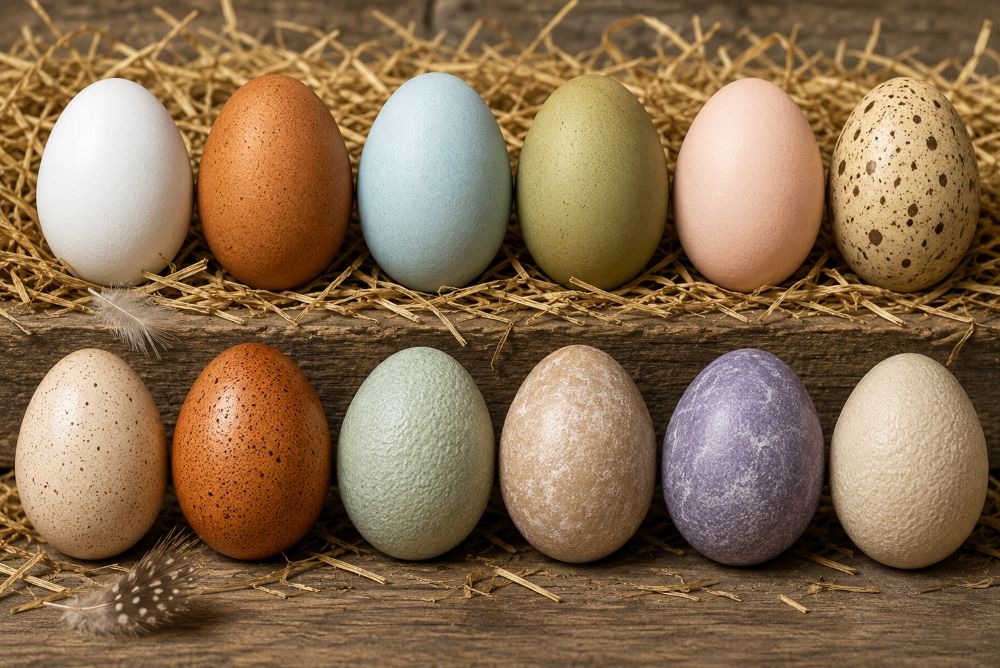
White Eggs
- Produced by breeds such as White Leghorn.
- Shell contains little to no pigment.
- Nutritionally similar to other shell colors.
Brown Eggs
- Produced by breeds such as Rhode Island Red and Plymouth Rock.
- Brown pigment is added during the final stage of shell formation.
Blue Eggs
- Produced by breeds such as Araucana and Ameraucana.
- Blue pigment permeates the entire shell, so the inside is also blue-tinted.
Green or Olive Eggs
- Produced by crosses often called Olive Egger.
- Result from a blue-shell gene combined with a brown-shell pigment layer.
Pink or Cream Eggs
- Some breeds lay eggs with a subtle pinkish or cream-colored appearance.
- Usually caused by a light brown pigment over a pale shell.
Shell Texture Variations
Eggshells can also vary in texture:
- Smooth shells – most common.
- Speckled shells – dark spots or freckles caused by extra pigment deposits.
- Bloom-coated shells – a natural protective coating called the cuticle can make eggs appear pink, purple, or matte.
Curiosity Query Fun Fact
The color of a chicken’s eggs is determined primarily by its genetics. A common rule of thumb is that chickens with white earlobes often lay white eggs, while those with red earlobes often lay brown eggs—but there are several exceptions. The shell color does not significantly affect taste or nutritional value.