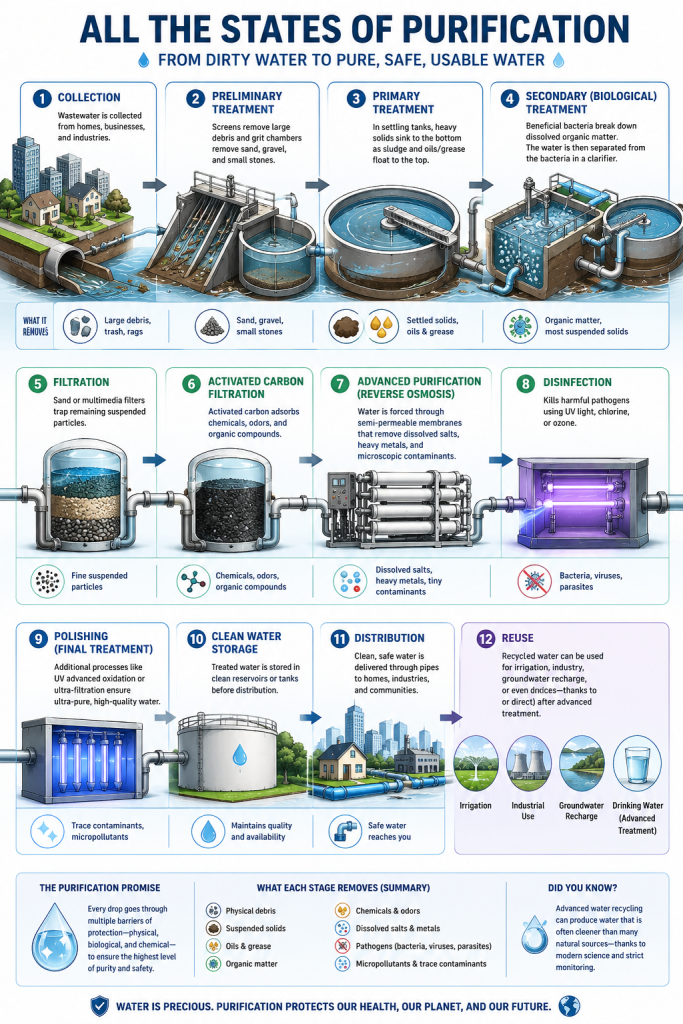
Water recycling is the process of cleaning used water so it can be safely reused instead of being discharged and wasted. The exact steps depend on whether the goal is irrigation, industrial use, or even drinking water.
1. Wastewater Collection
Water from homes, businesses, and industries flows through sewer systems to a treatment plant.
2. Preliminary Treatment
Large debris is removed:
- Screens catch rags, wipes, and trash.
- Grit chambers remove sand, gravel, and small stones.
3. Primary Treatment
Water enters large settling tanks called clarifiers.
- Heavy solids sink to the bottom as sludge.
- Oils and grease float to the top and are skimmed off.
This removes roughly 50–60% of suspended solids.
4. Secondary (Biological) Treatment
Beneficial bacteria are used to consume dissolved organic waste.
Common method:
- Aeration tanks pump oxygen into the water.
- Microorganisms “eat” sewage pollutants.
- Another clarifier separates the bacteria from the cleaned water.
This removes most remaining organic pollution.
5. Advanced Treatment (for Recycled Water)
Additional processes may include:
- Sand or membrane filtration
- Activated carbon filtration
- Nutrient removal (nitrogen and phosphorus)
- Reverse osmosis (RO)
Reverse osmosis membranes are fine enough to remove many dissolved contaminants, salts, and even viruses.
6. Disinfection
The water is disinfected using:
- Chlorine
- Ultraviolet (UV) light
- Ozone
This kills harmful bacteria, viruses, and parasites.
7. Reuse
The recycled water can then be used for:
- Irrigating parks and golf courses
- Agriculture
- Industrial cooling
- Groundwater recharge
- In some places, indirect or direct drinking water reuse
Can Recycled Water Become Drinking Water?
Yes. Some cities produce drinking water from wastewater through an advanced process:
The water typically goes through:
- Microfiltration
- Reverse osmosis
- UV light with hydrogen peroxide
- Extensive testing
The resulting water is often cleaner than many natural water sources because it is monitored continuously and treated to extremely high standards.
Fun Fact
On the International Space Station, astronauts recycle about 90–98% of their water, including moisture from breath, sweat, and wastewater. Without recycling, long-term space missions would be impossible.
In short, water recycling works by physically removing solids, biologically breaking down waste, filtering out microscopic contaminants, and disinfecting the water until it meets the quality required for its intended reuse.