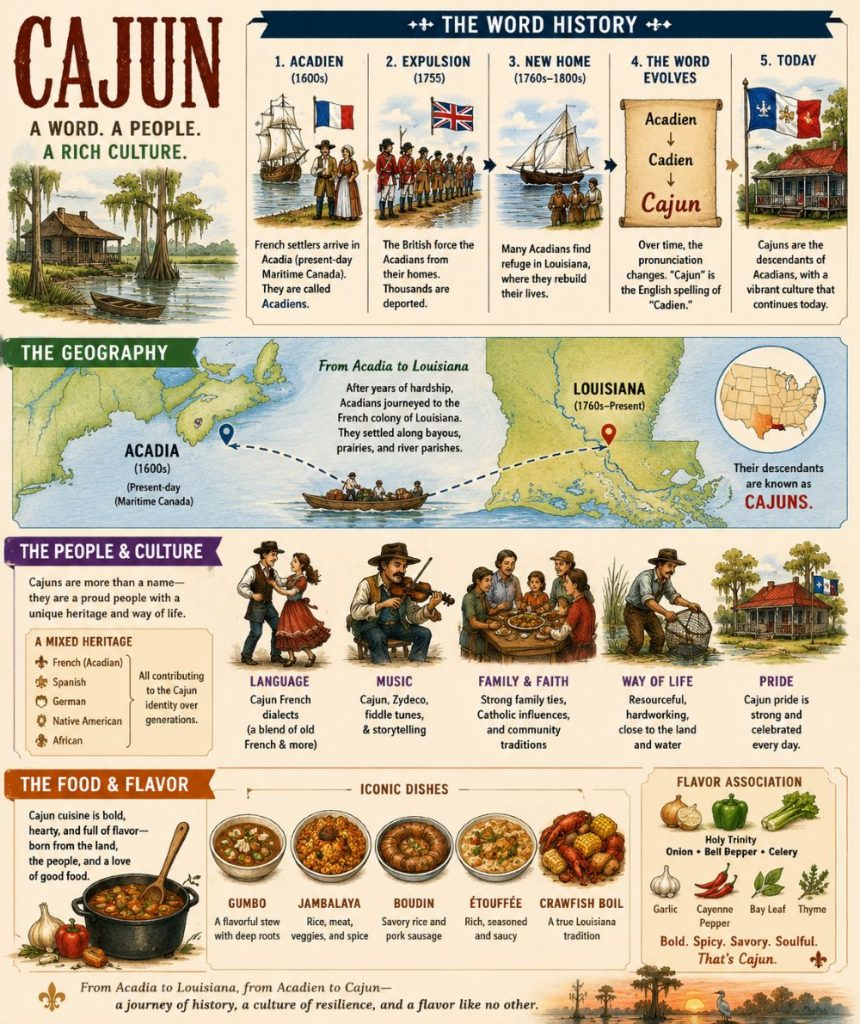
The word “Cajun” comes from “Acadian,” the name of French settlers who lived in the region of Acadia (now parts of Canada’s Maritime Provinces) during the 1600s and 1700s.
How “Acadian” became “Cajun”
- French settlers in Acadia were known as Acadiens (pronounced roughly “ah-kay-dyan”).
- In 1755, during the Expulsion of the Acadians, many Acadians were forcibly removed by the British.
- Thousands eventually resettled in what is now Louisiana.
- Over time, the pronunciation of Acadien evolved:
- Acadien → Cadien → Cajun
The English spelling “Cajun” reflects the local pronunciation of “Cadien.”
Who are Cajuns today?
Cajuns are descendants of these Acadian settlers, mixed over generations with other groups including French, Spanish, German, Native American, and African peoples. They developed a distinct culture known for:
- Cajun French dialects
- Unique music (Cajun and Zydeco)
- Cuisine such as gumbo, jambalaya, and boudin
- Strong traditions centered in southern Louisiana
A Curiosity Fun Fact:
Many Cajuns still refer to themselves as “Cadiens” (the French form), which is actually closer to the original word “Acadien” than the English word “Cajun.” So every time you hear “Cajun,” you’re hearing a linguistic shortcut that traces back more than 300 years to French-speaking settlers in Acadia.