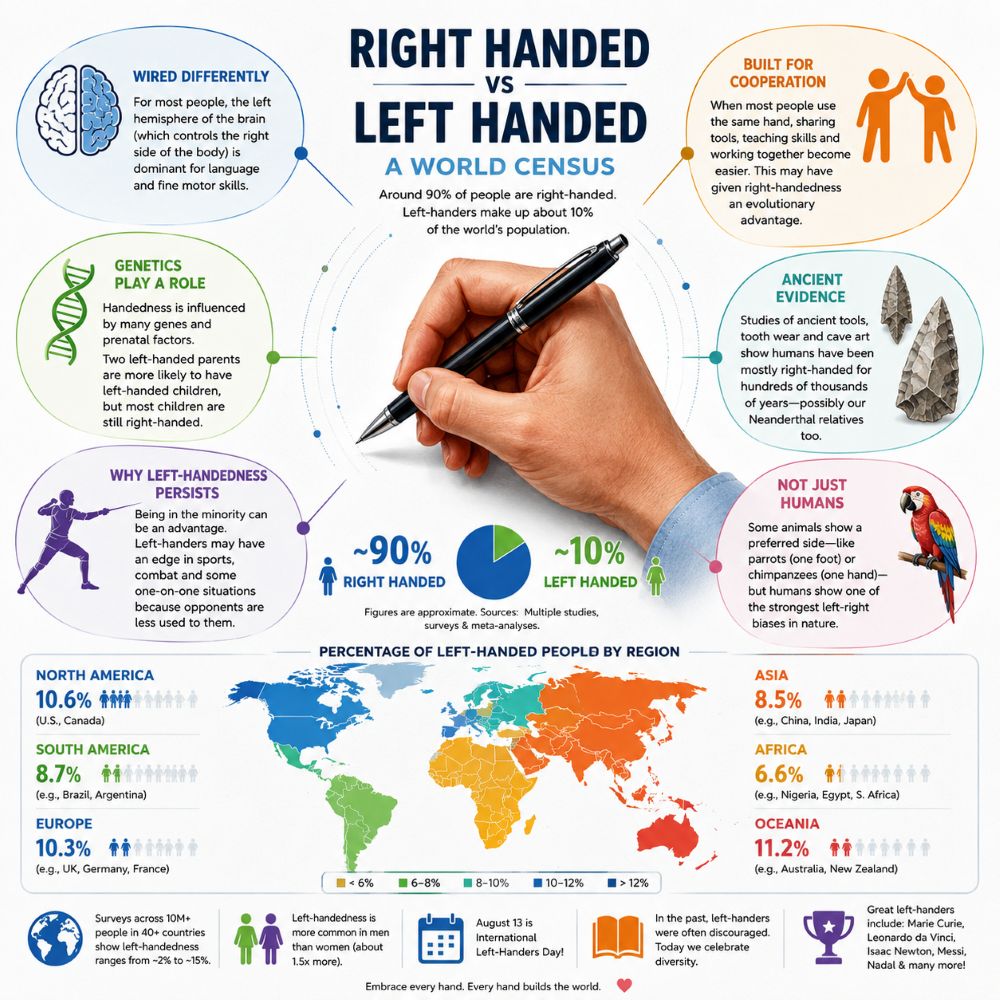
About 90% of humans are right-handed, while only about 10% are left-handed. Scientists still don’t have one single definitive answer, but several factors appear to contribute.
1. The Brain Is Slightly Asymmetrical
The human brain is divided into two hemispheres. For most people, the left hemisphere—which controls the right side of the body—is dominant for language and fine motor skills.
Because of this neurological organization, many people naturally develop stronger control of their right hand.
2. Genetics Play a Role
Handedness tends to run in families, but there is no single “left-handed gene.”
- Two right-handed parents are more likely to have right-handed children.
- Two left-handed parents have a higher chance of having left-handed children, but most of their children are still right-handed.
Scientists believe handedness results from a combination of many genes plus developmental factors before birth.
3. Social Cooperation May Have Favored Right-Handedness
One intriguing theory is that societies function better when most people use the same hand.
Imagine:
- Using shared tools
- Learning from others
- Fighting alongside allies
- Building equipment
When most people use the same hand, teaching and tool design become easier. This may have given right-handedness an evolutionary advantage.
4. Why Didn’t Left-Handedness Disappear?
Being a minority can sometimes be advantageous.
In sports and combat:
- Left-handed opponents are less common.
- Right-handed people have less experience facing them.
This “rare advantage” may help explain why left-handedness has persisted at roughly 10% throughout human history.
Evidence From Ancient Humans
Archaeologists have examined:
- Stone tools
- Wear marks on teeth
- Cave art
These clues suggest that even ancient humans were mostly right-handed, perhaps for hundreds of thousands of years.
A Curiosity Query Fun Fact:
Researchers estimate that even our extinct relatives, such as Neanderthals, were predominantly right-handed. Tooth wear patterns suggest a similar right-to-left ratio as modern humans, indicating that handedness may have deep evolutionary roots.
Are Other Animals Right-Handed Too?
Some animals show paw or limb preferences, but most do not display the strong population-wide bias humans do.
For example:
- Many parrots favor one foot.
- Some chimpanzees prefer one hand for certain tasks.
- Humans are unusual because an overwhelming majority share the same preference.
This makes human handedness one of the most pronounced left-right biases found in nature.