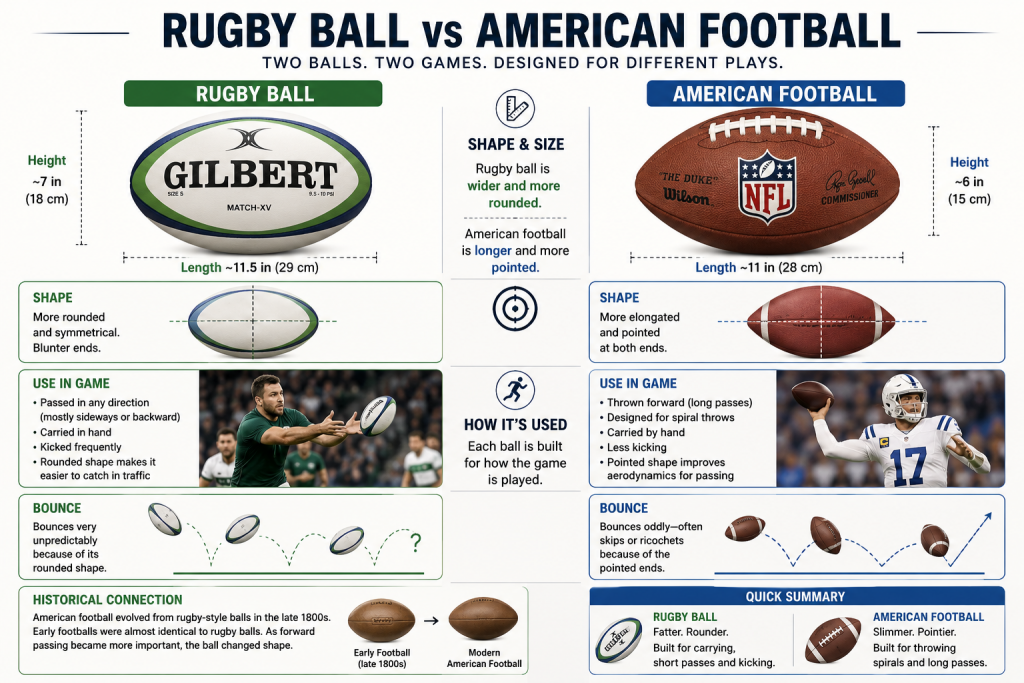
The rugby ball and the American football look similar, but they are designed differently for how each game is played.
Shape
Rugby Ball
- More rounded and wider.
- Nearly symmetrical from end to end.
- Easier to catch and pass with two hands.
American Football
- Longer and more pointed at both ends.
- Narrower in the middle.
- Designed for long spiral throws.
Size
| Feature | Rugby Ball | American Football |
|---|---|---|
| Length | ~11-12 in (28-30 cm) | ~11 in (28 cm) |
| Shape | More oval | More elongated |
| Point Ends | Blunter | Sharper |
Why the Difference?
Rugby
- Players frequently pass laterally and handle the ball in traffic.
- The rounder shape makes catching and carrying easier.
- Kicking is common, and the unpredictable bounce is part of the game.
American Football
- Forward passing is a major part of the sport.
- The pointed shape helps quarterbacks throw tight spirals over long distances.
- Better aerodynamics for passing.
Bounce
A rugby ball bounces very unpredictably because of its rounded oval shape.
An American football also bounces oddly, but its pointed ends often cause it to skip or ricochet in different directions.
Historical Connection
The American football evolved from rugby-style balls in the late 1800s. Early footballs were almost identical to rugby balls. As forward passing became important, the ball gradually became narrower and more pointed to improve throwing.
So if you put them side by side:
- Rugby ball = fatter, rounder, built for carrying and short passes.
- American football = slimmer, pointier, built for throwing spirals.