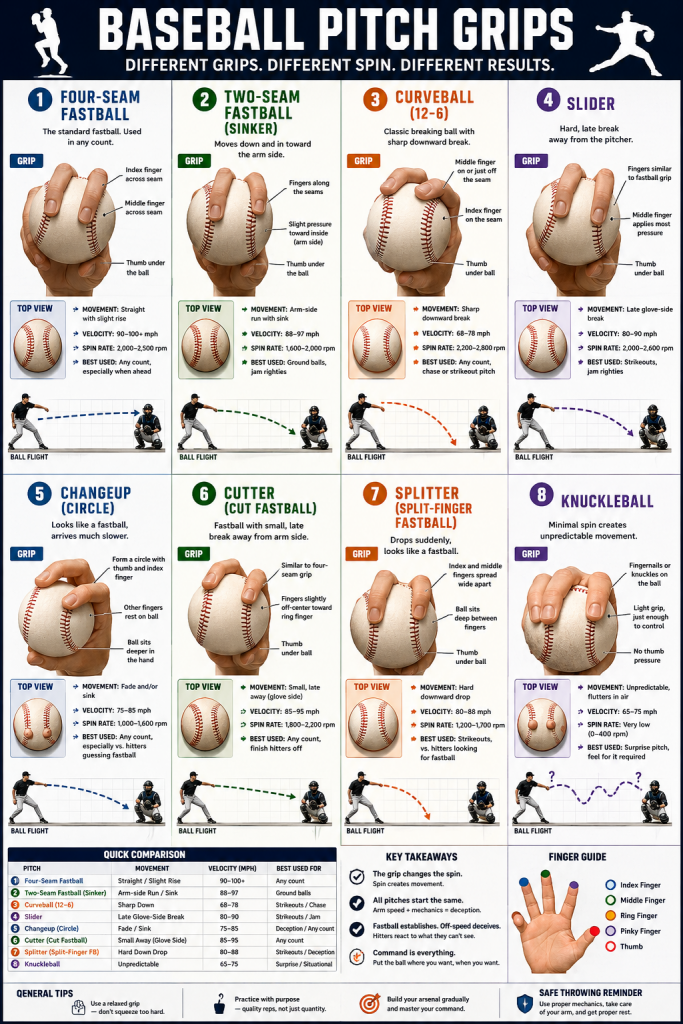
The grip determines how the ball spins, moves, and travels. Here are the most common baseball pitch grips:
1. Four-Seam Fastball
The basic and usually fastest pitch.
Grip:
- Index and middle fingers across the horseshoe seams.
- Thumb underneath the ball.
- Ball held with slight space from the palm.
Movement:
- Straight with slight rise illusion.
- Highest velocity.
2. Two-Seam Fastball (Sinker Variant)
Designed for arm-side movement.
Grip:
- Fingers run along the narrow seams.
- Slight finger pressure toward the inside.
Movement:
- Tails toward the pitcher’s arm side.
- Often sinks downward.
3. Curveball
A classic breaking pitch.
Grip:
- Middle finger on or near a seam.
- Thumb underneath.
- Wrist snaps downward at release.
Movement:
- Sharp downward break.
- Can resemble a “12-to-6” drop.
4. Slider
Harder and later-breaking than a curveball.
5
Grip:
- Similar to a fastball but slightly off-center.
- Middle finger applies most pressure.
Movement:
- Late glove-side break.
- Faster than a curveball.
5. Changeup
Looks like a fastball but arrives slower.
Grip:
- Circle formed with thumb and index finger.
- Ball sits deeper in the hand.
Movement:
- 8–15 mph slower than a fastball.
- Often fades and sinks.
6. Cutter (Cut Fastball)
A fastball that moves slightly away from the pitcher’s arm side.
Grip:
- Similar to a four-seam fastball.
- Fingers shifted slightly off-center.
Movement:
- Small, late break.
- Popularized by Mariano Rivera.
7. Splitter (Split-Finger Fastball)
Grip:
- Index and middle fingers spread wide apart.
- Ball sits deep between the fingers.
Movement:
- Drops suddenly near the plate.
- Looks like a fastball initially.
8. Knuckleball
One of the rarest pitches.
Grip:
- Fingernails or knuckles pressed into the ball.
- Minimal spin at release.
Movement:
- Floats unpredictably.
- Can dart in multiple directions due to air currents.