The reason we use 12-hour and 24-hour time instead of a more “decimal” system like 10 or 20 hours goes back thousands of years and has a lot to do with mathematics and ancient civilizations.
Why 12 Hours?
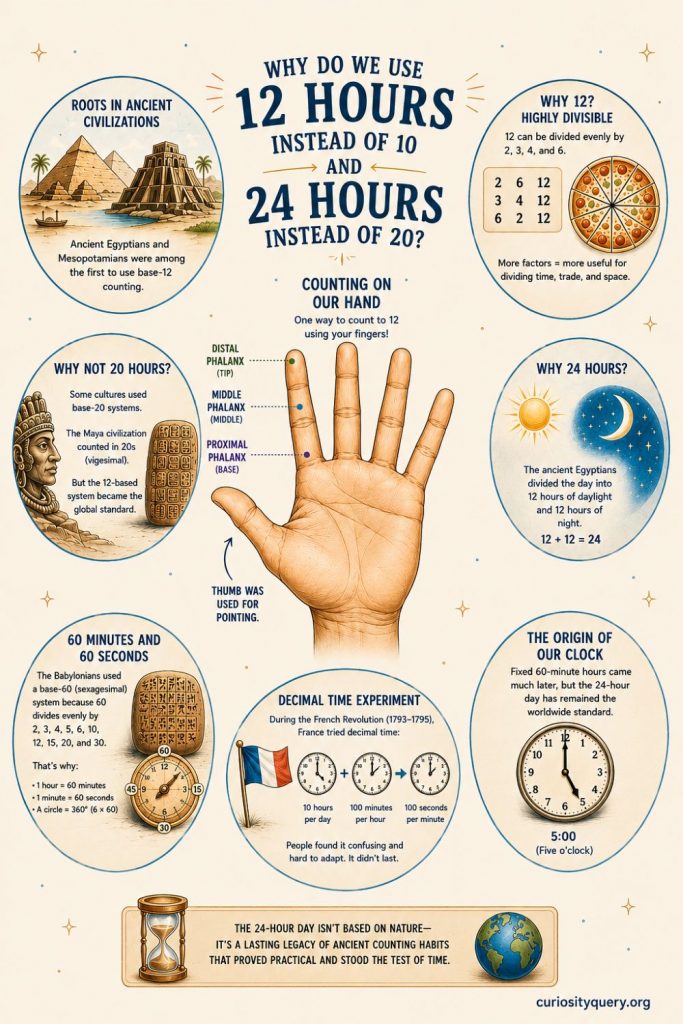
The earliest roots likely come from the ancient people of Ancient Egypt and Mesopotamia.
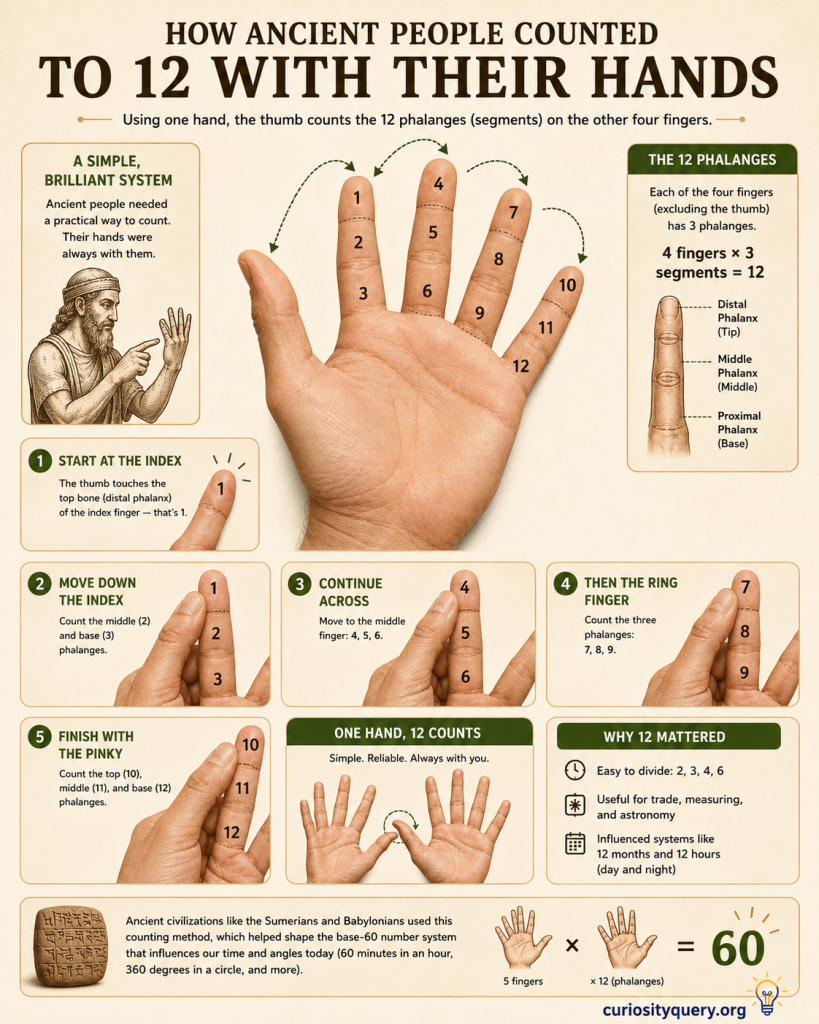
One popular theory is that people counted using their fingers:
- Use your thumb as a pointer.
- Each of the four fingers has 3 segments (phalanges).
- 4 fingers × 3 segments = 12.
This made 12 a very practical counting base.
Another advantage: 12 is highly divisible.
You can divide 12 evenly by:
- 2
- 3
- 4
- 6
By comparison, 10 divides evenly only by:
- 2
- 5
For trade, astronomy, and measuring time, 12 was often more convenient.
Why 24 Hours?
The ancient Egyptians divided:
- Daytime into 12 parts
- Nighttime into 12 parts
This produced 24 total hours.
Interestingly, those early “hours” weren’t fixed lengths. Summer daylight hours were longer than winter daylight hours. Fixed 60-minute hours came much later.
Why Not 20 Hours?
Some cultures actually used base-20 counting systems.
For example, the Maya civilization used a vigesimal (base-20) numbering system.
But the civilizations whose astronomy and mathematics heavily influenced Europe and the Middle East used bases centered around 12 and 60, which ultimately became the global standard.
Why 60 Minutes and 60 Seconds?
This comes from the ancient Babylonia civilization, which used a base-60 (sexagesimal) system.
60 is incredibly useful because it divides evenly by:
- 2
- 3
- 4
- 5
- 6
- 10
- 12
- 15
- 20
- 30
That’s why:
- 1 hour = 60 minutes
- 1 minute = 60 seconds
- A circle = 360 degrees (6 × 60)
Could We Have Used Decimal Time?
Yes. In fact, during the French Revolution, France briefly experimented with:
- 10 hours per day
- 100 minutes per hour
- 100 seconds per minute
But people hated converting everything they already knew, and the system never caught on.
A Fun Thought
If humanity had started with a decimal clock, noon today might be 5:00 instead of 12:00.
One decimal hour would equal 2 hours and 24 minutes on our current clocks, making a workday something like 3 decimal hours long.
The 24-hour day isn’t really based on any natural property of Earth—it’s mostly a consequence of ancient counting habits that turned out to be surprisingly practical and then became deeply embedded in civilization.