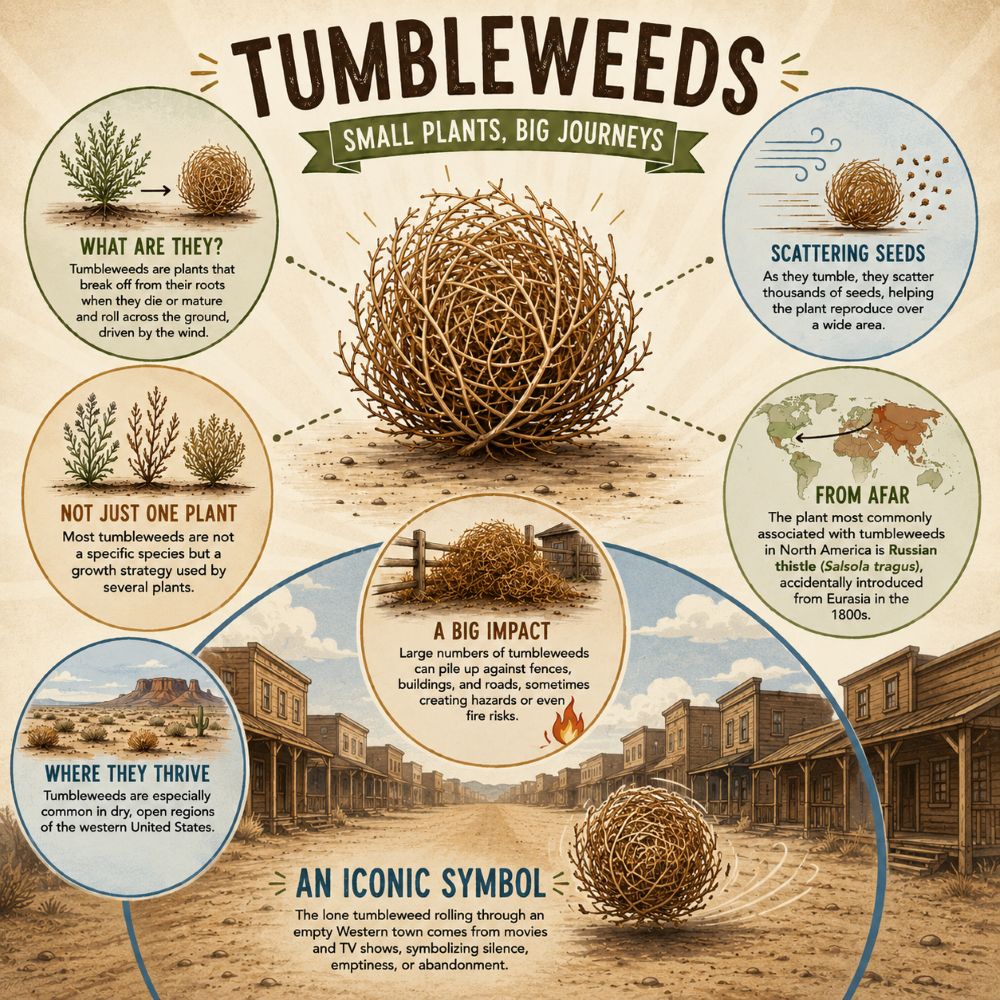
Tumbleweeds are plants that break off from their roots when they die or mature and then roll across the ground, driven by the wind. As they tumble, they scatter thousands of seeds, helping the plant reproduce over a wide area.
Tumbleweeds tumble because evolution turned the entire dead plant into a seed-dispersal vehicle.
When the plant matures:
- It produces thousands of seeds.
- The stem near the ground becomes brittle and breaks.
- Strong winds detach the plant from its roots.
- The round, lightweight structure acts like a natural wheel.
- As it rolls, seeds shake loose and scatter over large distances.
Why not just drop the seeds nearby?
In arid environments, dropping all seeds near the parent plant creates competition for:
- Water
- Sunlight
- Nutrients
By tumbling, a single plant can spread seeds for miles, increasing the chances that some will land in favorable conditions.
Why are they so round?
Many tumbleweed species grow with branching stems extending outward in all directions, naturally forming a roughly spherical shape. Once detached, this shape:
- Catches the wind efficiently
- Rolls rather than drags
- Protects seeds inside the tangled branches
Think of a tumbleweed as nature’s version of a self-propelled seed package. Instead of relying on animals or birds, the entire plant becomes a giant rolling delivery system.
Curiosity Query Fun Fact:
One famous tumbleweed, Russian thistle, can release tens of thousands of seeds during its journey, which is why a single plant can help create large tumbleweed populations across open landscapes.