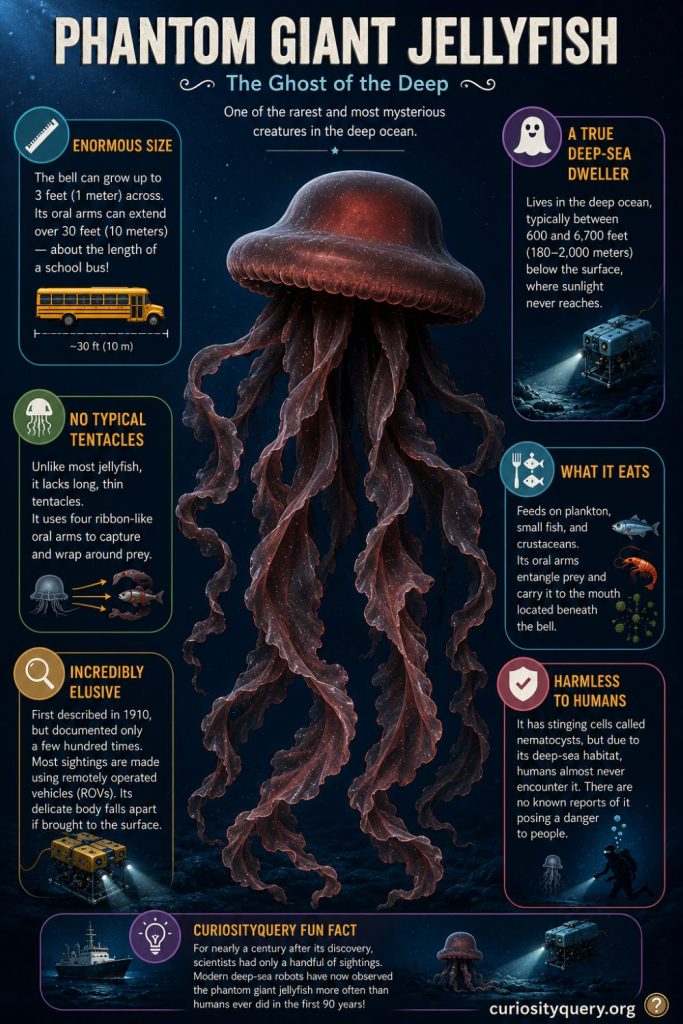
The phantom giant jellyfish (scientific name: Stygiomedusa gigantea) is one of the rarest and most mysterious jellyfish in the ocean. It lives in the deep sea, typically between 600 and 6,700 feet (180–2,000 meters) below the surface, where sunlight never reaches.
Here are some of the most fascinating facts:
- It’s enormous. The bell (the main body) can grow to about 3 feet (1 meter) across, while its four ribbon-like oral arms can extend over 30 feet (10 meters)—about the length of a school bus.
- It has no typical tentacles. Unlike most jellyfish, it lacks the thin, stinging tentacles people usually associate with jellyfish. Instead, it uses its long, flat oral arms to capture and wrap around prey.
- It drifts like a ghost. Its slow, graceful movement and dark reddish-brown coloration inspired its common name, “phantom giant jellyfish.”
- It’s incredibly elusive. Since it inhabits the deep ocean, scientists have only documented it a few hundred times, mostly using remotely operated vehicles (ROVs). Very few specimens have ever been collected because its delicate body falls apart when brought to the surface.
- It eats small animals. Its diet includes plankton, small fish, and crustaceans. Once prey becomes entangled in its oral arms, it is transported to the mouth located beneath the bell.
Why is it so rarely seen?
The deep ocean is one of the least explored places on Earth. More than 90% of the ocean’s habitat lies below 200 meters (656 feet), where exploration requires specialized submarines or robotic vehicles. The phantom giant jellyfish spends its entire life in this dark environment, making encounters exceptionally uncommon.
Does it sting humans?
Probably not in any meaningful way. Like other jellyfish, it has stinging cells called nematocysts, but because it lives so deep, humans almost never encounter it. There are no known reports of it posing a danger to people.
CuriosityQuery Fun Fact
The phantom giant jellyfish was first described in 1910, but for nearly a century scientists had only a handful of sightings. Modern deep-sea robots have now observed it more often than humans ever did in the first 90 years after its discovery.
Its haunting appearance and rarity have made it one of the most iconic—and least understood—creatures of the deep ocean.