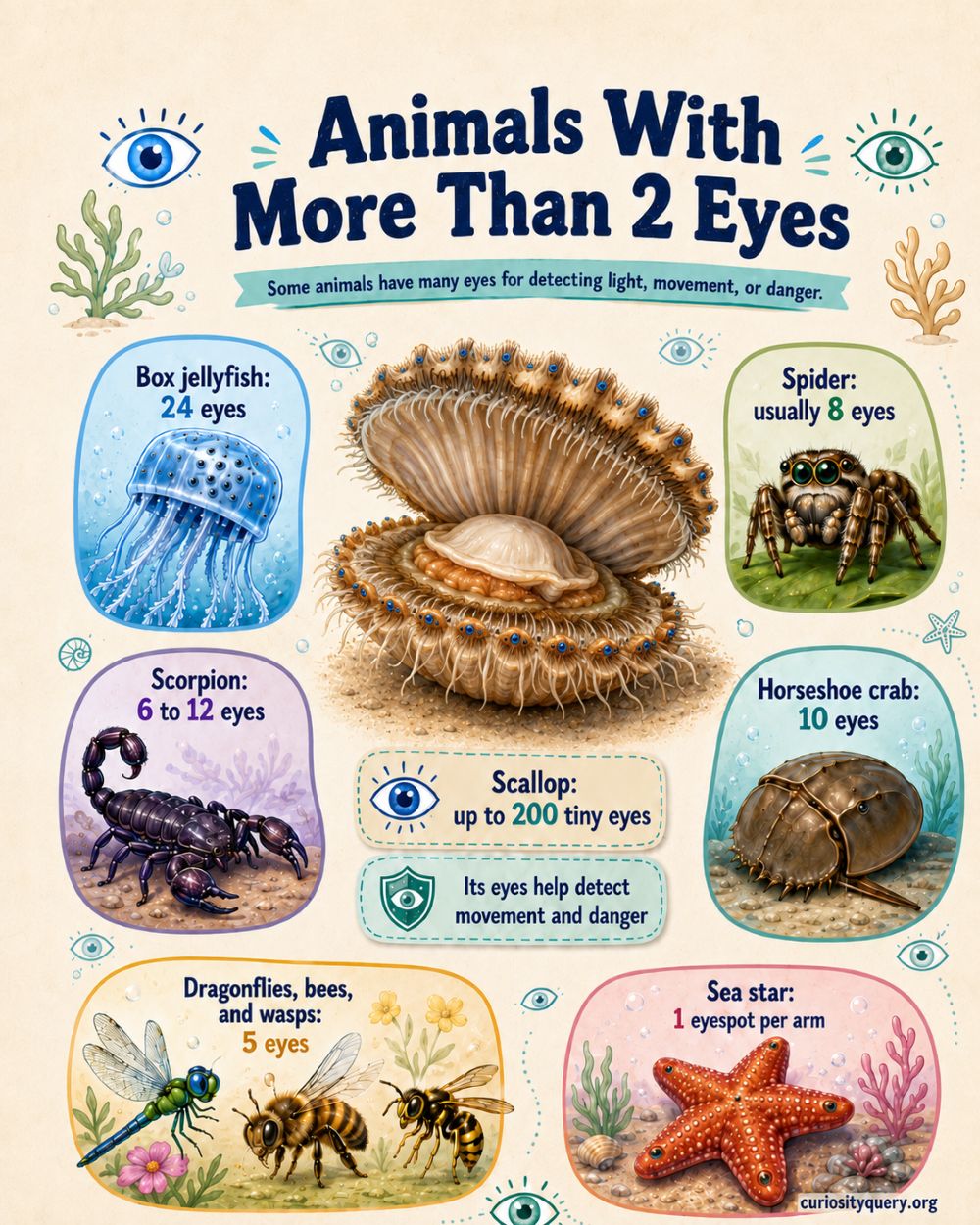
Many animals have more than two eyes, although some of those eyes are simple light detectors rather than detailed, image-forming eyes.
- Scallops — up to about 200 eyes. The tiny blue eyes form rows along the edge of the mantle. Unusually, they use microscopic mirrors rather than a conventional lens to focus light.
- Box jellyfish — 24 eyes. They have four sensory structures, each containing six eyes of several types. Some form images, while others mainly detect light or movement.
- Scorpions — commonly 6–12 eyes. They generally have two central eyes plus two to five pairs of smaller lateral eyes; some cave-dwelling species are eyeless.
- Horseshoe crabs — 10 eyes. These include two prominent compound eyes and several smaller light-sensitive eyes on the shell and near the tail.
- Spiders — usually eight eyes. Some species have six or fewer, and many spiders rely more heavily on vibrations than vision.
- Dragonflies, bees and many wasps — five eyes. They have two large compound eyes plus three small simple eyes called ocelli, which help detect light and stabilize flight.
- Sea stars — usually one eyespot per arm. A typical five-armed sea star therefore has five eyespots, while species with many arms may have considerably more.
Curiosity Query fact: Having more eyes does not necessarily mean sharper vision. A scallop may possess roughly 200 eyes, but each mainly helps it notice movement, shadows and approaching danger rather than see the detailed world humans do.
Sources: Information for this infographic was verified using research and educational material from Science, the Smithsonian Institution, Woods Hole Oceanographic Institution, the Australian Museum, the San Diego Zoo, and peer-reviewed studies available through PubMed Central. These sources document scallops’ numerous mantle eyes, box jellyfish’s 24-eye visual system, spiders’ usual eight eyes, scorpions’ central and lateral eyes, horseshoe crabs’ multiple visual organs, insects’ compound eyes and ocelli, and the eyespots found at the tips of sea-star arms.