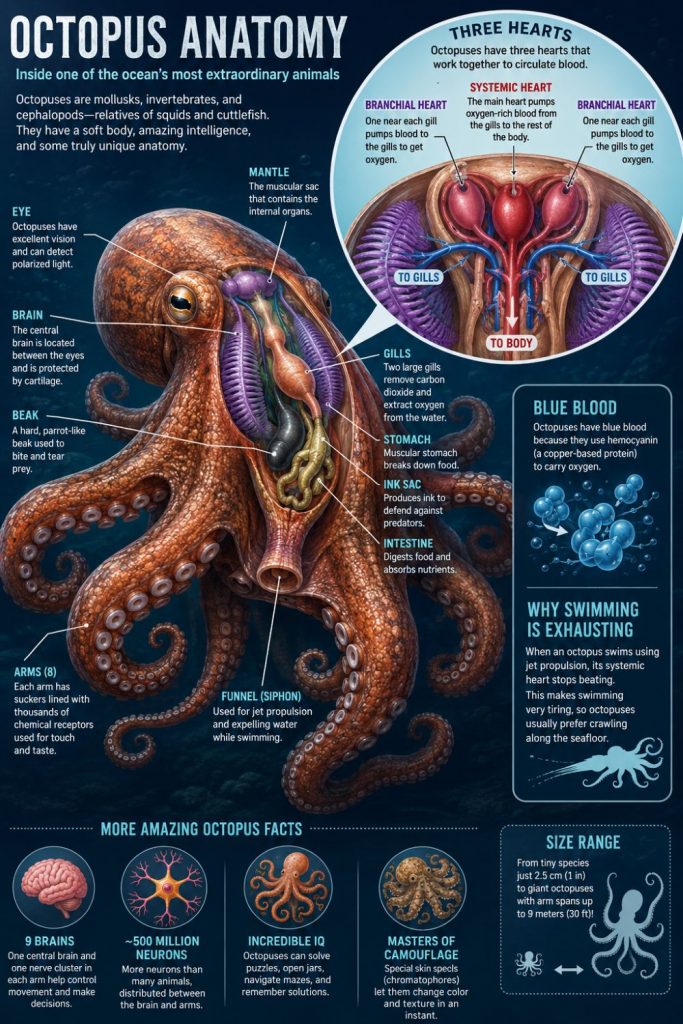
Octopuses evolved three hearts because their circulatory system has a difficult job.
The challenge: moving oxygen efficiently
Unlike humans, octopuses use blue blood containing Hemocyanin rather than hemoglobin. Hemocyanin is excellent in cold, low-oxygen ocean environments but is generally less efficient at carrying oxygen than hemoglobin.
To compensate, octopuses evolved a specialized pumping system:
Heart #1: Systemic Heart
- Pumps oxygen-rich blood to the entire body.
- Equivalent to your main heart.
Hearts #2 and #3: Branchial Hearts
- One for each gill.
- Pump oxygen-poor blood through the gills where oxygen is absorbed from seawater.
Think of it like a plumbing system:
Body
 ↓
Branchial Heart (Left) → Left Gill
 ↓
Systemic Heart
 ↑
Branchial Heart (Right) → Right Gill
 ↑
Body
Why not just one bigger heart?
Because the blood pressure drops significantly when blood passes through the delicate gill tissues. Having dedicated “booster pumps” before the gills ensures enough blood reaches them, while the systemic heart can focus on delivering oxygenated blood to the rest of the body.
An engineering analogy
As an IT infrastructure director, you can think of the branchial hearts as two edge routers feeding traffic into a core network, while the systemic heart acts as the core switch distributing data throughout the enterprise. Separating those jobs makes the whole system more efficient.
A curious side effect
When an octopus swims by jet propulsion, its systemic heart temporarily stops beating. That’s one reason octopuses tire quickly and often prefer crawling along the seafloor.
CQ Fun Fact:
An octopus doesn’t have three hearts because it’s more active than humans—it has three hearts because its blue-blood chemistry and gill-based circulation require extra pumps just to move oxygen efficiently.