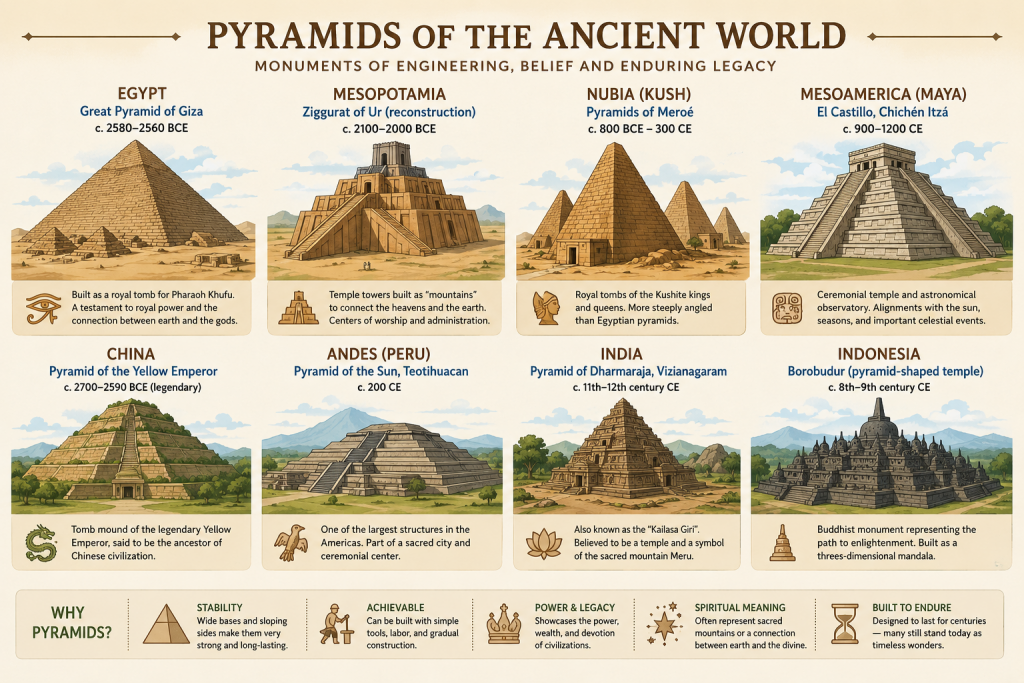
Pyramids became popular in several ancient civilizations because they are one of the most practical ways to build very large structures using stone, mud brick, or earth without modern engineering.
1. They are extremely stable
A pyramid naturally directs most of its weight downward and inward.
Think of stacking blocks:
- A tall vertical wall can collapse outward.
- A pyramid gets wider toward the bottom, making it resistant to gravity and erosion.
- Ancient builders didn’t need steel beams, concrete reinforcement, or advanced mathematics to make it stand.
2. They can be built with simple technology
Ancient societies had:
- Human labor
- Ramps
- Ropes
- Sleds
- Simple tools
A pyramid’s shape allows workers to gradually add layers upward. There is no need for long unsupported spans or complex arches.
3. They symbolize power and permanence
Many rulers wanted monuments that would:
- Last for centuries
- Demonstrate wealth and authority
- Connect them to gods or ancestors
A massive pyramid visible for miles sent a powerful message:
“Our civilization is organized, wealthy, and powerful.”
4. Religious and cosmic symbolism
Different cultures associated pyramid-like structures with sacred mountains or the heavens.
For example:
- Great Pyramid of Giza was part of a royal tomb complex linked to the divine status of Egyptian pharaohs.
- El Castillo served ceremonial and astronomical purposes for the Maya.
- Mesopotamian ziggurats were artificial mountains where temples connected earth and sky.
5. They survive better than most buildings
Many ancient palaces, houses, and temples disappeared because:
- Roofs collapsed
- Wood rotted
- Walls fell outward
A pyramid has no large roof to fail and no heavy upper walls pushing outward. As a result, thousands of years later, many pyramids are still standing.
Why do we see pyramids in different parts of the world?
Interestingly, civilizations in:
- Egypt
- Sudan
- Mexico
- Peru
- Ancient Mesopotamia
all independently developed pyramid-like structures.
Most historians believe this happened because the pyramid is a natural engineering solution: if you want to build the tallest possible structure with primitive technology, a pyramid is one of the safest and simplest shapes available.
A useful way to think about it is:
Ancient pyramids were the skyscrapers of their time—monumental structures that showcased engineering skill, religious belief, and political power.