We always see the same side of the Moon because the Moon is tidally locked to Earth.
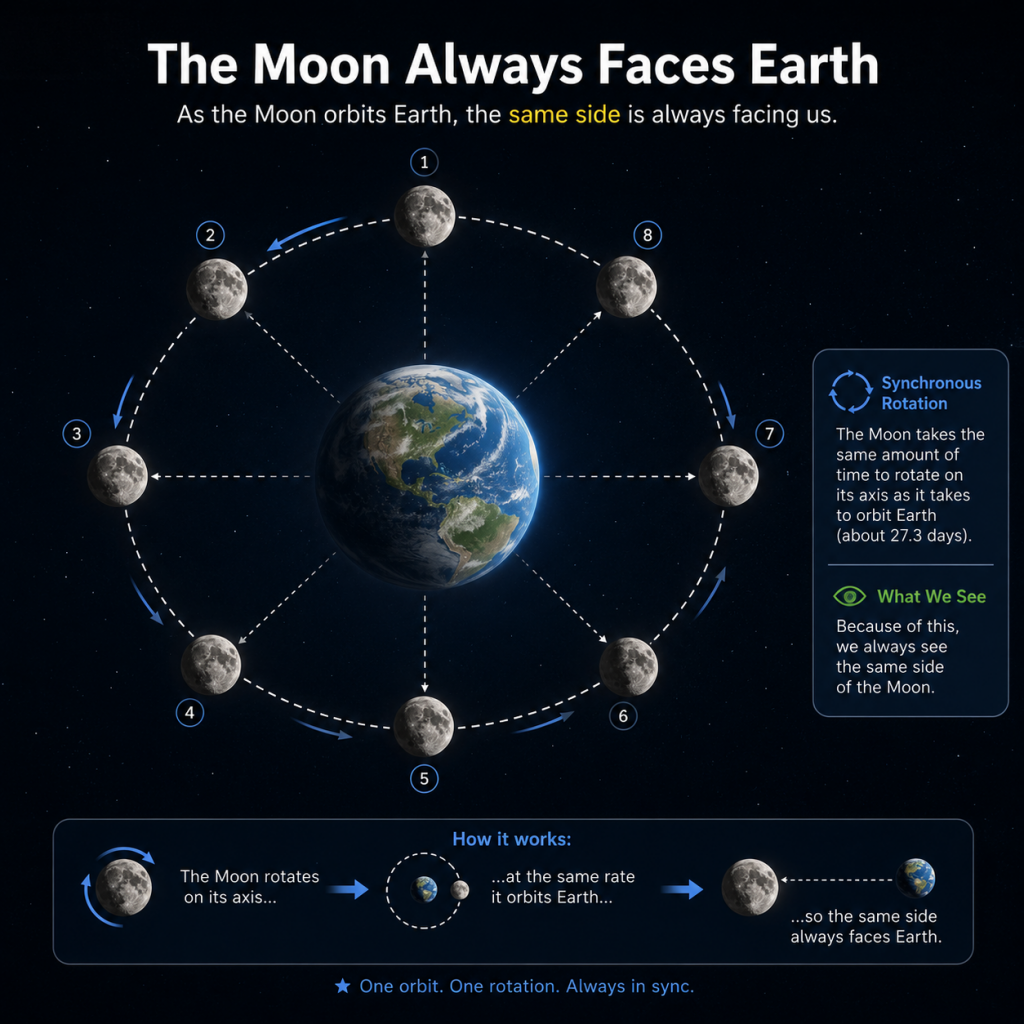
Here’s what that means:
- The Moon rotates on its axis once every 27.3 days.
- The Moon also orbits Earth once every 27.3 days.
- Because these two periods are exactly the same, the same hemisphere of the Moon is always pointed toward Earth.
Think of it like this:
Imagine you’re walking in a circle around a table while always facing the table. As you go around:
- You are turning your body.
- You complete one full turn during one full trip around the table.
- The table always sees your face, never your back.
That’s exactly what the Moon does with Earth.
Common misconception
Many people think the Moon doesn’t rotate at all. If that were true, we would eventually see all sides of the Moon as it orbited Earth.
Instead, the Moon rotates just enough to keep one side facing us.
Why did this happen?
Billions of years ago, Earth’s gravity created tidal bulges in the Moon. Over time, these gravitational forces acted like a brake on the Moon’s rotation until it settled into a stable state where:
- 1 rotation = 1 orbit
This is called synchronous rotation or tidal locking.
What about the “dark side”?
The far side of the Moon is often incorrectly called the “dark side.”
The far side receives just as much sunlight as the side facing Earth. A better term is the far side of the Moon: Far side of the Moon
Visual summary
Orbit around Earth:   1 revolution
Rotation on axis:     1 rotation

Result:
       🌕
        ↺
     ↗     ↘
   🌍       🌍

Same lunar face always points toward Earth.
The animation you requested earlier is a perfect illustration of this synchronization: the Moon is constantly rotating as it orbits, but it rotates at exactly the right rate to keep the same face pointed at Earth.
A better analogy
Imagine a slightly squashed tennis ball rather than a perfectly round ping-pong ball. The stretching is real, but very subtle—only about 0.1% of the Moon’s size. That tiny elongation, combined with Earth’s gravity, helps keep the same side facing us.
The Moon is therefore:
- Not a perfect sphere
- Slightly elongated toward and away from Earth
- Gravitationally locked into that orientation by tidal forces